
Used Job Site Office Trailers — Compare Up To 5 Supplier Quotes For Re-Deployable Inventory
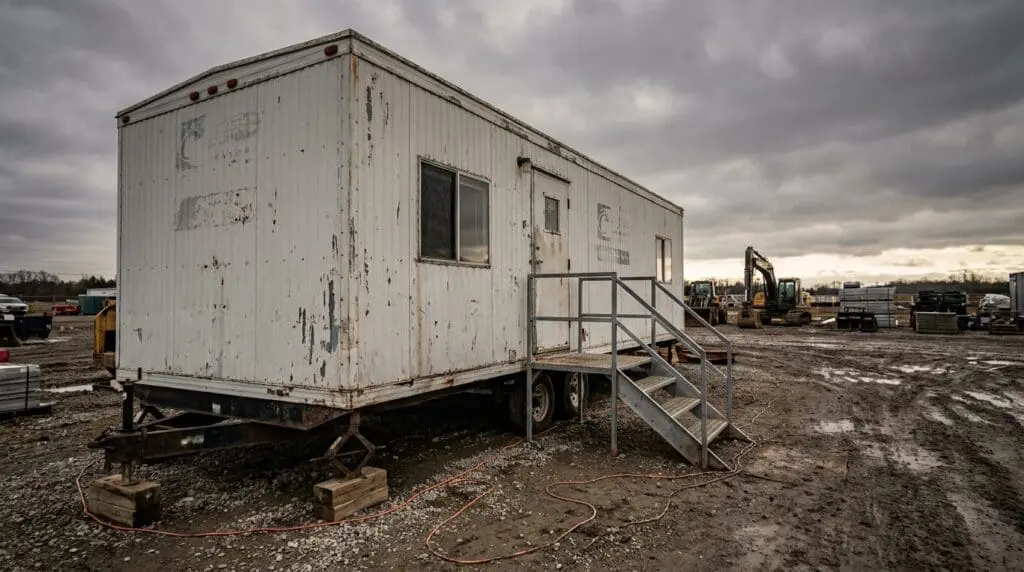
Jobsite duty is harder on a trailer than office-park duty — dust, vibration, weather, generator power, and repeated transport between projects. A used jobsite-grade unit at the right price is one of the best capital plays in the category, if you know what to inspect. We send your spec to up to 5 reputable suppliers in your market for competing quotes.
Why Used For Jobsites
Re-Deployable Across Projects — The Math That Makes Used Jobsite Trailers Win
A used jobsite office trailer earns its money differently than a corporate-park unit. The same 8×20 trailer that sits 15 years on a fixed property may need refit work after 8 years of jobsite duty — dust intrusion, vibration from heavy equipment running 50 feet away, generator-powered electrical that swings outside grid spec, and the wear of being moved every 12–24 months. The right used unit absorbs that duty cycle and still has 5–8 productive years left across 3–5 follow-on jobs.
That re-deployability is the buy case. A new trailer amortizes against one project’s books and bleeds depreciation in year one. A used unit at the right price has the steepest part of the curve already absorbed by the prior owner. You buy at the flat part, run it across multiple jobs, and the per-project cost drops fast. Most contractors who buy used jobsite trailers are paying for the unit by the second project and running pure margin from there.
The trade-off is variability. You’re inheriting another contractor’s history — what jobs the unit sat on, what got patched, what didn’t. The fastest way to start: have up to 5 reputable suppliers in your market quote on the same spec with full disclosure on age, condition, prior service, and the recent transport history. Compare like-for-like.
Jobsite Inspection Checklist
What To Verify Before You Buy A Used Jobsite Trailer
These six items wear harder under jobsite conditions than they do under office-park use. The broader inspection items still matter — see the used office trailer page for the general checklist. The list below is the jobsite-specific overlay. Reputable suppliers will document each in the quote or send photos and service records on request.
Frame & Axle From Repeated Transport
Office-park units sit. Jobsite units move. Ask for the unit’s transport history — how many moves, what distances, and any documented frame work. Inspect axle mounts, hitch, cross-members, and the leveling-jack pads for stress cracks or repair welds.
Exterior Skin & Skirting Damage
Active jobsites rarely treat trailers gently. Skin dents, corner trim damage, and missing or bent skirting are common. Cosmetic damage is fine; impact damage that compromises the weather envelope is not. Ask for daylight photos of every side.
HVAC With Jobsite Dust Service History
Jobsite dust loads commercial HVAC filters 3 to 5 times faster than office air. A used jobsite trailer with no service record on the HVAC is a near-term cost. Ask for last filter change, last coil cleaning, and the operating-hours estimate from the prior owner.
Electrical Panel & Generator Hookup
Jobsite power is rougher than grid power. Generator voltage swings, dirty waveforms, and cycle drops shorten breaker and panel life. Inspect for burn marks at breakers, check the GFCI test on every wet-zone outlet, and confirm the transfer-switch rating matches the panel amperage.
Door Weatherstrip & Window Seals
High traffic jobsite doors cycle 50–200 times a day. Weatherstrip compression, door-sweep wear, and window-seal cracking show up far faster than on office-park units. Replacing weatherstrip is cheap; chasing leaks they caused is not.
Restroom Plumbing If Equipped
Jobsite water hookups vary widely — municipal, well, hauled, or none. That variability is hard on tank seals, supply lines, and the macerator pump on flush-system units. Get the last service date, ask whether it ran on hauled water, and inspect tank fittings.
Common Sizes For Jobsite Use
What’s On The Used Jobsite Market
Re-Deployment Math
Buy Used Vs Rent Across Multiple Jobs
The decision is mostly about how many follow-on jobs the unit will see. Single-project rental math favors rent below 18 months. Once you cross into the multi-project re-deployment zone, used purchase pulls ahead fast — you’re amortizing one capital outlay across several project budgets and recovering resale value at the end.
| Re-Deployment Plan | Recommended Path | Why |
|---|---|---|
| 1 project, under 12 months | Rent | Rental beats purchase math at this duration. See used trailer rental options for the lower up-front commitment. |
| 1 project, 12–24 months | Compare both | Rent-to-own structures often credit a portion of rent toward a buy. Some suppliers do, some don’t — ask explicitly when you compare quotes. |
| 2–3 follow-on jobs over 3–5 years | Buy used | The unit pays for itself by the second project. Per-project cost drops sharply from job 2 onward, and end-of-life resale recovers a meaningful portion. |
| 4+ follow-on jobs / 5+ years | Buy used | Best math case for used. The unit amortizes across the full re-deployment cycle and runs pure margin after the first 1–2 jobs. |
See the used construction trailer pillar → · Compare against the broader used-office buy →
Common Questions
FAQ
What makes a used jobsite trailer different from a used office trailer?
Same hardware in most cases, but a different duty cycle. Jobsite units see dust, vibration, generator power, and repeated transport that office-park units don’t. The same trailer that lasts 15 years on a fixed corporate property may need refit work after 8 years of jobsite life. Inspection priorities shift to frame, axles, weatherstrip, and HVAC service history.
How many years of life remain in a typical used jobsite unit?
A well-maintained used jobsite trailer in the 5 to 10 year zone typically has 5 to 8 productive years of jobsite duty left. Units 10 to 15 years old can still earn their keep if HVAC, roof, and electrical are documented as recently serviced. Anything past 15 years should come with current service records on all major systems.
What inspection should I require before purchase?
Daylight photos of all four sides, the underside (frame, axles, hitch, leveling jacks), the roof, the HVAC unit nameplate, and the electrical panel. Service records for HVAC and any major repairs. Transport history from the prior owner. For higher-spend units, a third-party mobile-office inspection is worth the small added cost.
Can the unit be transported between jobs?
Yes — that’s the whole re-deployment case. Most 8×20 through 10×50 units move on standard permits in most states. 12-foot-wide units and double-wides need wide-load permits and sometimes pilot vehicles. Confirm clean title and current axle and wheel tags so transport stays straightforward.
What restroom-equipped variants are common in used inventory?
10×40 with single restroom and 12×60 doubles with restroom plus break area are the most common. Used inventory carries a premium reflecting the rebuild cost on plumbing — tank seals, supply lines, and macerator pumps wear faster on jobsites with hauled-water service. Ask for the last plumbing service date and water-source history.
How fast can a used jobsite trailer deliver?
Faster than new. Common 8×20 and 10×40 sizes from regional suppliers can deliver within 3–7 business days from quote acceptance. Larger or specialty configurations — 12×60 doubles, ADA-compliant, custom layouts — take 2–3 weeks to source and prep. Specify your project start date in the form so suppliers quote against a real timeline.
How does this service work?
You submit one form with project type, size or size range, condition preference, delivery ZIP, project duration, and contact email. We send the request to up to 5 reputable used jobsite trailer suppliers in your market. They submit competing quotes, typically within an hour during business days. Free, no obligation. We’re paid by suppliers when they win your business — you pay nothing.
Stop Calling Suppliers One At A Time
One form. Up to 5 reputable suppliers compete for your used jobsite trailer purchase. Quotes back in about an hour during business days. Free, no obligation. No pushy sales calls.