
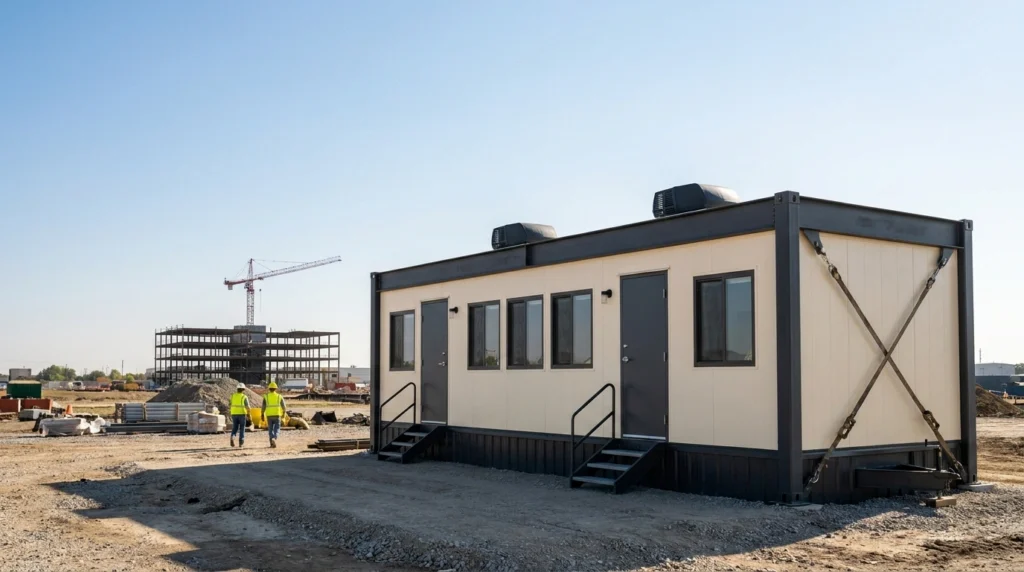
Office Trailer Permits by State — Do You Need One, and Who Issues It
Compare up to 5 quotes from reputable suppliers who handle delivery and site logistics. About one hour to get bids back. Free, no obligation — you pay nothing; suppliers pay us when they win your business.
Start Here
Do You Actually Need A Permit For An Office Trailer?
The honest answer is that it depends — on how the trailer is used and how long it stays — and the decision is made by your local jurisdiction, not by any single national rule. Before you request quotes, it helps to know which of two situations you are in, because they point to very different answers.
When an office trailer sits on an active construction site that is already operating under a valid building permit, the trailer is often treated as part of that permitted work, and a separate permit is commonly not required. When a trailer is placed on its own — a standalone sales office on a lot, a semi-permanent office on private property, or a unit that stays for many months — a local temporary-use, zoning, or building permit is more often needed. These are typical patterns, not guarantees: the same trailer can be treated differently one county over.
Because the call is local, the reliable move is to confirm with the city or county building department that covers your address before the unit ships. Reputable suppliers place thousands of these units a year and can tell you what they usually see in a given market, but the binding answer comes from your local permitting authority. The rest of this page maps out who to ask, and for what.
The Split
Two Permits, Two Authorities: Transport vs. Placement
Most of the confusion around office trailer permits comes from treating it as one question when it is really two, handled by two different authorities. Separating them makes the whole process easier to plan.
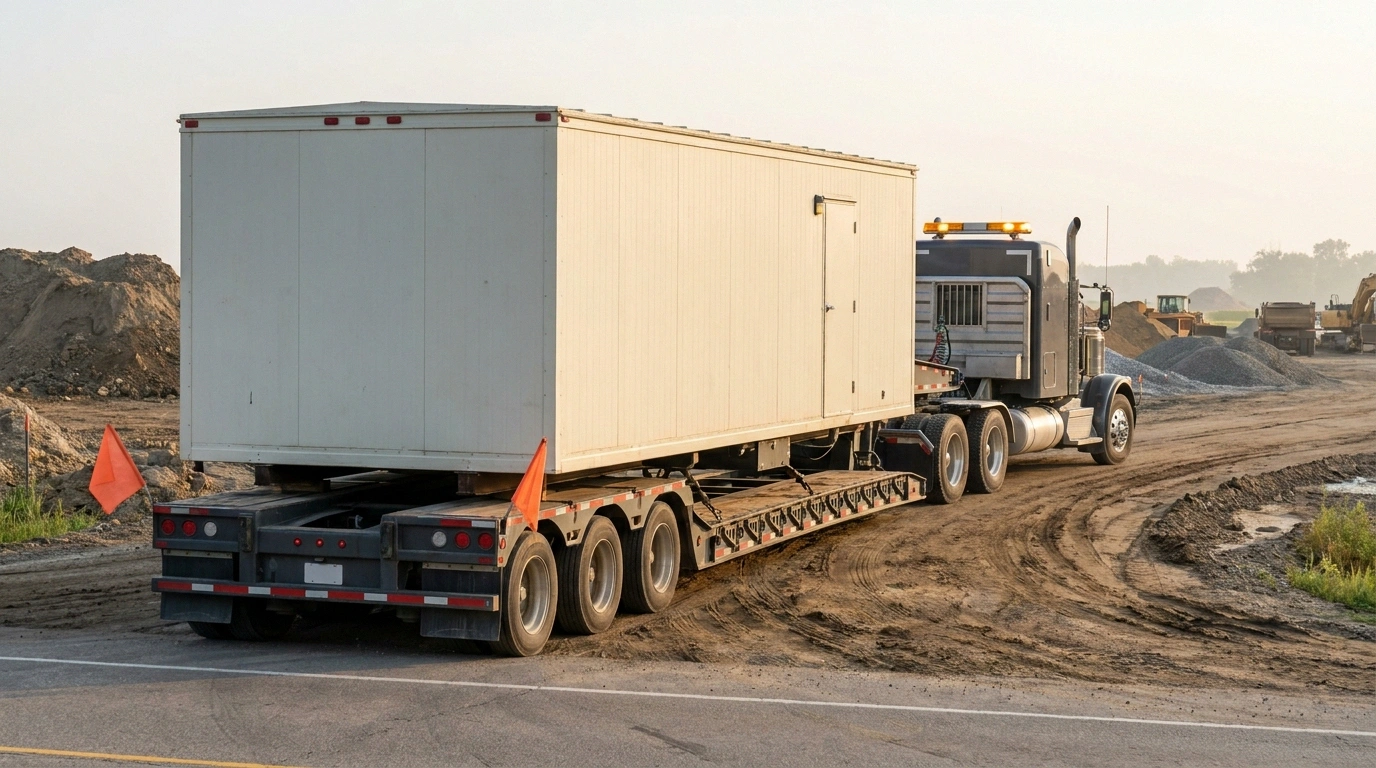
Getting it there — transport and oversize permits (state level). Moving a trailer over public roads can require a hauling permit from the state Department of Transportation or DMV. An 8-foot-wide unit usually travels as a standard load, while a 10- or 12-foot-wide unit typically ships as an oversize load that needs a state oversize or overweight permit, and sometimes a pilot escort. In practice the supplier and their hauler arrange these permits as part of delivery, but the cost is real and worth comparing across bids.
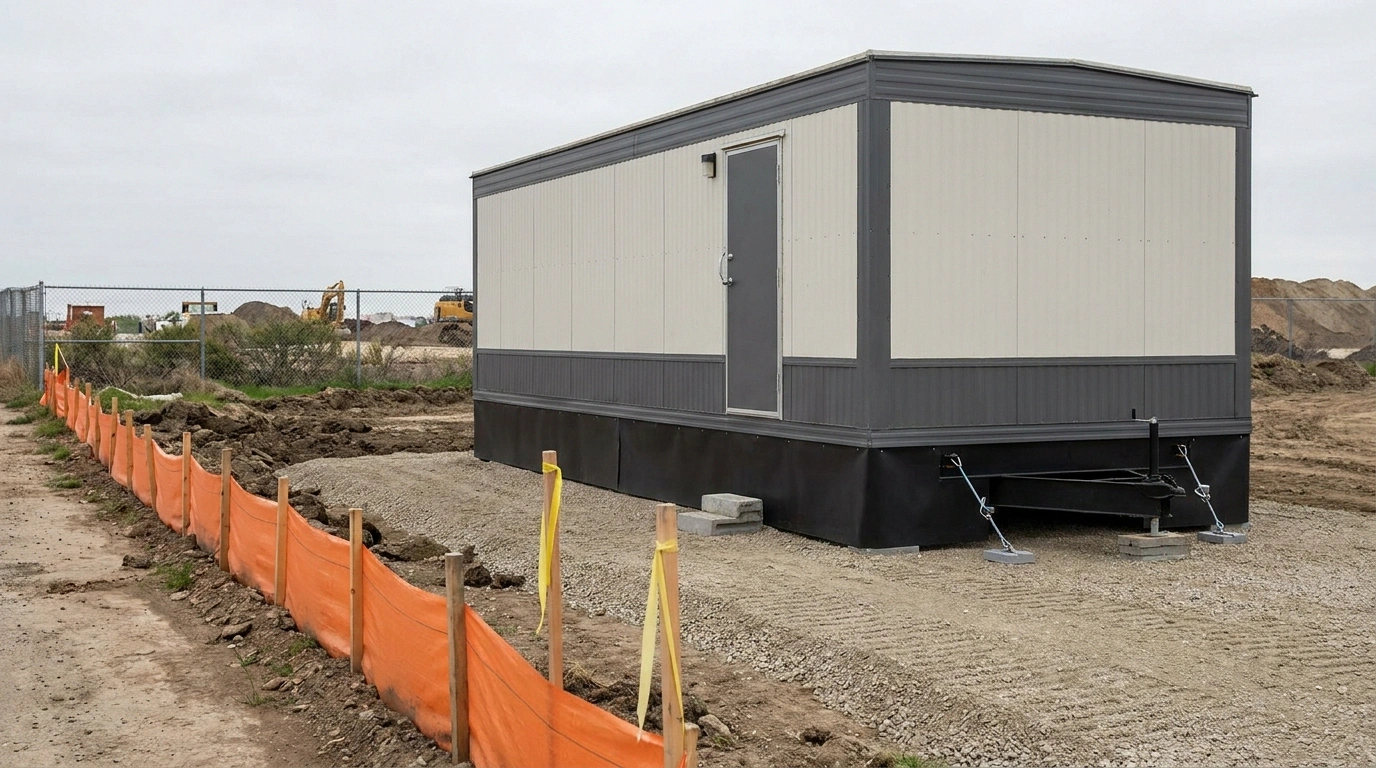
Siting it — placement and zoning permits (local level). Setting the trailer on the ground is governed by the local municipality or county building department. This is where zoning district, property-line setbacks, tie-downs and wind anchoring, utility hookups, egress, and accessibility come in. In building-code terms this is usually handled as a “temporary structure” or “temporary use,” and many jurisdictions have a specific temporary-use permit for it. Almost nobody publishes these two tracks side by side, which is why buyers get conflicting answers — the transport answer and the placement answer are simply different questions.
By State
Permit Outlook By State — A 50-State Reference
Use the table as a starting map, not a rulebook. It is built on one truth that holds in nearly every state: placement permitting is decided at the city or county level, so there is no single statewide “office-trailer rule” to look up. That is why the placement column names the authority to ask — your local building department — rather than a fabricated per-state answer. The transport column points to the state agency that issues oversize road permits. Each state links to its local landing page, where suppliers who work that market can walk you through the local process.
Read every row the same way: for placement, confirm with your local building department; for transport, the supplier’s hauler works with the state DOT or DMV. A few states route oversize permits through a motor-vehicle or motor-carrier division rather than the DOT — Texas, for example, issues them through the TxDMV — so if you are arranging a move yourself, search “[your state] oversize load permit” for the exact office. Washington, D.C. has no standalone state landing page here; its row links to the Washington, D.C. city page instead.
| State | Placement & zoning permit — who decides (local) | Transport / oversize permit — who issues (state) |
|---|---|---|
| Alabama | City / county building dept — temporary-use / zoning | Alabama DOT / DMV |
| Alaska | City / county building dept — temporary-use / zoning | Alaska DOT / DMV |
| Arizona | City / county building dept — temporary-use / zoning | Arizona DOT / DMV |
| Arkansas | City / county building dept — temporary-use / zoning | Arkansas DOT / DMV |
| California | City / county building dept — temporary-use / zoning | California DOT / DMV |
| Colorado | City / county building dept — temporary-use / zoning | Colorado DOT / DMV |
| Connecticut | City / county building dept — temporary-use / zoning | Connecticut DOT / DMV |
| Delaware | City / county building dept — temporary-use / zoning | Delaware DOT / DMV |
| Florida | City / county building dept — temporary-use / zoning | Florida DOT / DMV |
| Georgia | City / county building dept — temporary-use / zoning | Georgia DOT / DMV |
| Hawaii | City / county building dept — temporary-use / zoning | Hawaii DOT / DMV |
| Idaho | City / county building dept — temporary-use / zoning | Idaho DOT / DMV |
| Illinois | City / county building dept — temporary-use / zoning | Illinois DOT / DMV |
| Indiana | City / county building dept — temporary-use / zoning | Indiana DOT / DMV |
| Iowa | City / county building dept — temporary-use / zoning | Iowa DOT / DMV |
| Kansas | City / county building dept — temporary-use / zoning | Kansas DOT / DMV |
| Kentucky | City / county building dept — temporary-use / zoning | Kentucky DOT / DMV |
| Louisiana | City / county building dept — temporary-use / zoning | Louisiana DOT / DMV |
| Maine | City / county building dept — temporary-use / zoning | Maine DOT / DMV |
| Maryland | City / county building dept — temporary-use / zoning | Maryland DOT / DMV |
| Massachusetts | City / county building dept — temporary-use / zoning | Massachusetts DOT / DMV |
| Michigan | City / county building dept — temporary-use / zoning | Michigan DOT / DMV |
| Minnesota | City / county building dept — temporary-use / zoning | Minnesota DOT / DMV |
| Mississippi | City / county building dept — temporary-use / zoning | Mississippi DOT / DMV |
| Missouri | City / county building dept — temporary-use / zoning | Missouri DOT / DMV |
| Montana | City / county building dept — temporary-use / zoning | Montana DOT / DMV |
| Nebraska | City / county building dept — temporary-use / zoning | Nebraska DOT / DMV |
| Nevada | City / county building dept — temporary-use / zoning | Nevada DOT / DMV |
| New Hampshire | City / county building dept — temporary-use / zoning | New Hampshire DOT / DMV |
| New Jersey | City / county building dept — temporary-use / zoning | New Jersey DOT / DMV |
| New Mexico | City / county building dept — temporary-use / zoning | New Mexico DOT / DMV |
| New York | City / county building dept — temporary-use / zoning | New York DOT / DMV |
| North Carolina | City / county building dept — temporary-use / zoning | North Carolina DOT / DMV |
| North Dakota | City / county building dept — temporary-use / zoning | North Dakota DOT / DMV |
| Ohio | City / county building dept — temporary-use / zoning | Ohio DOT / DMV |
| Oklahoma | City / county building dept — temporary-use / zoning | Oklahoma DOT / DMV |
| Oregon | City / county building dept — temporary-use / zoning | Oregon DOT / DMV |
| Pennsylvania | City / county building dept — temporary-use / zoning | Pennsylvania DOT / DMV |
| Rhode Island | City / county building dept — temporary-use / zoning | Rhode Island DOT / DMV |
| South Carolina | City / county building dept — temporary-use / zoning | South Carolina DOT / DMV |
| South Dakota | City / county building dept — temporary-use / zoning | South Dakota DOT / DMV |
| Tennessee | City / county building dept — temporary-use / zoning | Tennessee DOT / DMV |
| Texas | City / county building dept — temporary-use / zoning | Texas DOT / DMV |
| Utah | City / county building dept — temporary-use / zoning | Utah DOT / DMV |
| Vermont | City / county building dept — temporary-use / zoning | Vermont DOT / DMV |
| Virginia | City / county building dept — temporary-use / zoning | Virginia DOT / DMV |
| Washington | City / county building dept — temporary-use / zoning | Washington DOT / DMV |
| West Virginia | City / county building dept — temporary-use / zoning | West Virginia DOT / DMV |
| Wisconsin | City / county building dept — temporary-use / zoning | Wisconsin DOT / DMV |
| Wyoming | City / county building dept — temporary-use / zoning | Wyoming DOT / DMV |
| Washington, D.C. | District building dept — temporary-use / zoning | DDOT (District DOT) |
Placement authority is local everywhere in the table because that is genuinely how office-trailer permitting works — the row names who to ask, and on an active jobsite under a valid building permit a separate placement permit is often not required. Always confirm the specifics with your local building department before the unit ships.

Beyond The Permit
Common Compliance Points: Setback, ADA, Utilities
Whether or not a standalone permit is required, a placement review usually touches the same handful of points. Knowing them ahead of time keeps a delivery from stalling.
Zoning setback
Even a temporary structure generally has to sit a minimum distance from property lines, and that distance is set by the zoning district your site falls in. Ranges vary widely by municipality, so treat any number you hear as typical rather than fixed and confirm it locally. Our office trailer setback requirements guide covers property-line and zoning setbacks in depth, and our guide to construction trailers and zoning restrictions covers how zoning shapes placement.
ADA accessibility
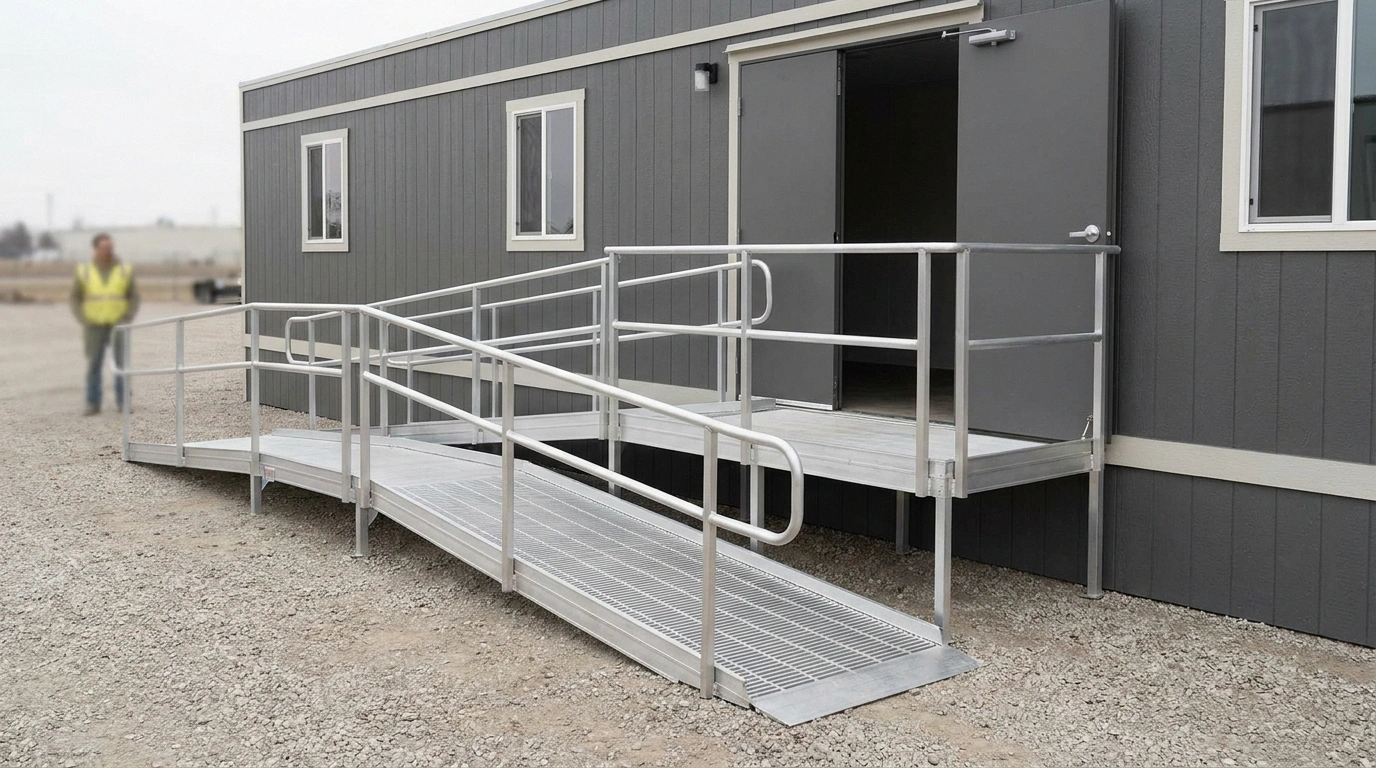
When an office trailer is a place of employment or serves the public, accessibility requirements commonly apply. The figures people reference most often — a ramp slope no steeper than 1:12, a clear door width of about 32 inches, and roughly a 60-inch turning space inside, plus an accessible restroom — come from the 2010 ADA Standards and are best treated as typical targets. For a binding determination, check the current ADA Standards with the U.S. Access Board or an accessibility professional. Our ADA-compliant office trailer guide walks through the ramp, doorway, and restroom configurations in more detail.
Utilities, anchoring, and egress
Placement review often also looks at power, water and sewer or a holding tank, tie-downs and wind anchoring, and a clear means of egress. These overlap with jobsite safety practices — our notes on staying compliant on the job site and office-trailer safety best practices cover the day-to-day side. When you request quotes, tell suppliers your site conditions up front so the right setup and any local requirements are built into the bid rather than discovered on delivery day. If you are still weighing configurations, the used construction trailer market and our office trailer dimensions guide can help you match a unit to the site.
Common Questions
FAQ — Office Trailer Permits
Do I need a permit to put an office trailer on my jobsite?
It depends on your municipality and how the trailer is used. On an active construction site already operating under a valid building permit, a temporary office trailer is often covered by that permit and not separately permitted. A standalone or long-term placement — a sales office on a lot, or a unit that stays for many months — more often needs its own temporary-use, zoning, or building permit. These are common patterns, not guarantees, so confirm with the city or county building department that covers your address before the unit ships.
Who issues office trailer permits?
Two different authorities, for two different things. Placement and zoning — siting the trailer on the ground — is handled by your local municipal or county building department. Transport of the unit over public roads, including oversize permits for wider trailers, is handled at the state level by the Department of Transportation or DMV. Separating the two makes the process much easier to plan, because the answer to “can I put it here” comes from the local building department and the answer to “how do we move it” comes from the state.
Is an office trailer considered a temporary structure?
In most building codes a jobsite office trailer is treated as a temporary structure or temporary use, and many jurisdictions have a specific temporary-use permit that covers it. How long “temporary” runs before a unit is treated as more permanent varies by jurisdiction, and a longer stay can change the requirements. Your local building department can tell you how they classify it and what, if anything, that classification requires.
Do I need a permit to transport or move an office trailer?
Moving a trailer over public roads can require a hauling permit from the state DOT or DMV. An 8-foot-wide unit usually travels as a standard load, while a 10- or 12-foot-wide unit typically ships as an oversize load that needs a state oversize or overweight permit and sometimes a pilot escort. In practice the supplier and their hauler arrange these permits as part of delivery, so you rarely handle them yourself — but the cost is real, and it is worth comparing across quotes.
Are there setback requirements for an office trailer?
Usually, yes. Even a temporary structure generally has to sit a minimum distance from property lines, set by the zoning district your site falls in. The specific distances vary widely by municipality, so treat any figure you hear as typical rather than fixed and confirm it with your local building or zoning department. Telling your supplier the site dimensions up front helps them recommend a unit that fits with room to spare.
Does an office trailer need to be ADA accessible?
When the trailer is a place of employment or serves the public, accessibility requirements commonly apply. Frequently referenced figures — a ramp slope no steeper than 1:12, about a 32-inch clear door width, roughly a 60-inch interior turning space, and an accessible restroom — come from the 2010 ADA Standards and are best treated as typical targets. For a binding answer for your specific use, check the current ADA Standards with the U.S. Access Board or an accessibility professional, and ask suppliers about ADA-ready ramp and restroom options when you request quotes.
How does this quote-comparison service work?
You submit one form with your project type, the size you need, rent or buy, delivery ZIP, project duration, configuration needs, and contact email. We send the request to up to 5 reputable office trailer suppliers serving your market. They submit competing quotes, typically within an hour during business days, and can advise on the delivery and placement logistics they usually see locally. You compare and decide. It is free, with no obligation. We are paid by suppliers when they win your business — you pay nothing.
Compare Office Trailer Quotes From Up To 5 Reputable Suppliers
One form, any size or configuration. Up to 5 reputable suppliers who handle delivery, transport permits, and site logistics compete for your job. Quotes back in about an hour during business days. Free, no obligation. No pushy sales calls.